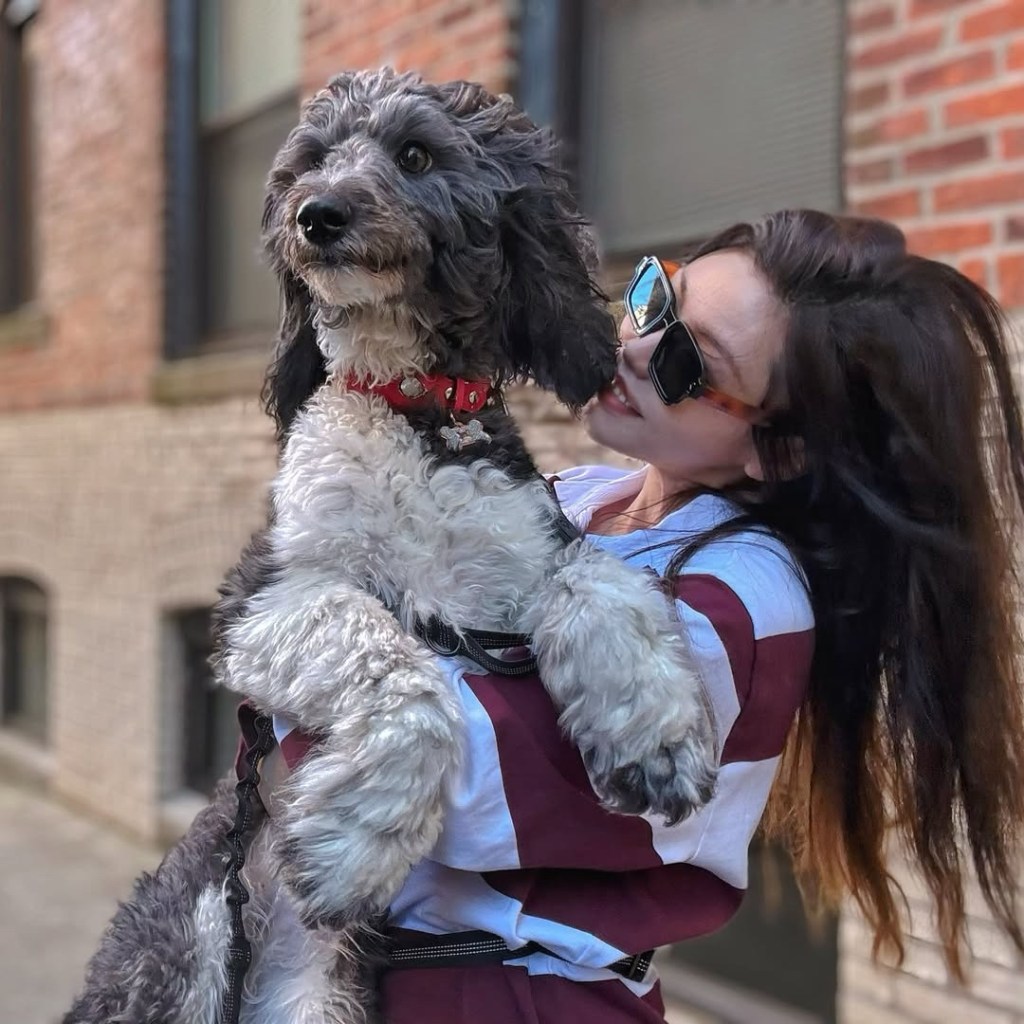
I didn’t write this when it happened. I told myself I would, but every time I tried, my chest tightened like the story was physically trapped inside me. Some grief doesn’t arrive as tears—it arrives as avoidance. It arrives as “maybe later,” until later becomes months, and you realize you’ve been carrying something too heavy to name.
Doodle was diagnosed with hemangiosarcoma in August, and we said goodbye in November 2025. Three months doesn’t sound like a lifetime, but it became one. I’m writing this now not because it hurts less now, but because I want her story to exist outside my body.
The first sign was… sleep
The first sign didn’t look like a disaster. It looked like sleep.
At first it was easy to explain away. Doodle just seemed a little more tired. A little quieter. The kind of tiredness you blame on weather, age, or a lazy day. She still ate, still wagged her tail, still followed me around like she always did—but there were moments where her eyes looked distant in a way that made my stomach twist. When she got up, she moved like her body had to remember how. When she laid down, it was like gravity finally won.
People talk about intuition like it’s mystical, but sometimes it’s just love paying attention. I could feel something changing even when I couldn’t prove it. Doodle wasn’t dramatic. She wasn’t crying. She wasn’t asking for help in any obvious way. She was just… fading, slightly. Quietly. Like someone slowly turning down the volume on the world.
Hemangiosarcoma: the cancer that hides
Hemangiosarcoma is cruel because it often begins quietly and hides in places you can’t see. It’s one of the most devastating cancers dogs can get, not only because it’s aggressive, but because it’s so good at pretending it isn’t there—until it is.
Hemangiosarcoma is a malignant cancer of blood vessel–forming cells. That means the tumor is made of fragile, abnormal vessels that fill with blood. It doesn’t always behave like a solid “lump” you can simply remove and forget about. It behaves more like unstable blood-filled tissue that can leak or rupture, causing internal bleeding. The spleen is one of the most common places it grows, and the danger is that a splenic hemangiosarcoma can bleed silently at first or rupture suddenly without warning.
That’s why the earliest symptoms can look vague: weakness, lethargy, pale gums, reduced appetite, a dog that just seems “off.” If blood is leaking internally, the body starts compensating—less circulating blood means less oxygen delivery, and that can show up as fatigue long before anything looks like an emergency.
The day I realized she wasn’t just tired
By the time we went to the vet, I had already started bargaining with myself. I kept thinking maybe I was overreacting, maybe she just needed rest, maybe I was projecting fear onto something normal. But the appointment felt heavy from the beginning, like the air knew something my brain still refused to say.
I remember sitting in the exam room watching her breathe, trying to interpret every tiny movement as a message. The vet asked the usual questions, checked her vitals, looked at her gums, gently examined her abdomen. Doodle stayed quiet, not scared, just tired. Then they did imaging, and the tone shifted—not panic, but that careful professional seriousness that makes your skin go cold.
They found a mass on her spleen.
The word mass is one of those words that doesn’t sound scary until it lands in your life. It turns your mind into a storm. They explained the danger: splenic masses can rupture and bleed internally, sometimes slowly and sometimes catastrophically. Whether it was benign or malignant, the immediate risk was real, and surgery was the safest path forward.
The decision: surgery
So we chose surgery. Of course we did.
A splenectomy—removing the spleen—can stop the bleeding and remove the primary tumor. It can buy time, and at that moment time felt like everything. I signed papers with shaking hands, trying to act like a person who knows how to do this. When they took her through the back door, it felt like my heart went with her.
Waiting was torture. Minutes stretched into something sharp and unbearable. I stared at my phone like attention alone could keep her alive. When they finally called and told me she made it through, relief hit so hard I cried until my whole body hurt. I don’t think I realized how terrified I was until that terror finally had somewhere to go.
After surgery: the hope era
When Doodle came home, she looked smaller in a way I wasn’t ready for. Her belly was shaved. Her incision was clean and unreal, a line that didn’t belong on someone so soft. She moved carefully like the world had become fragile, but she was here. She was alive. She still leaned into my hand like nothing in the universe was safer than me.
The days after surgery were a strange, temporary peace. I tried to make her world quiet and warm. I followed medication schedules like rituals. Every little improvement felt like proof we were winning. She started eating more, walking steadier, wagging her tail again, and I let myself picture a future, even though I knew better.
I didn’t realize how powerful hope can be until I watched it return. Hope is dangerous because it makes you plan again. It makes you forget you’re standing near a cliff.
The pathology report
Then came the pathology report, the official name for the thing we were afraid to say.
Hemangiosarcoma.
The vet explained it gently, but the meaning was brutal. This cancer is aggressive and tends to spread early—often before it’s ever detected. Removing the spleen can remove the main tumor, but it doesn’t guarantee the disease hasn’t already traveled somewhere else, like the liver, lungs, or heart. That’s the nightmare of it: you can do everything right and still lose.
We talked about chemotherapy, about quality of life, about what “more time” might look like. But even in those conversations, I could feel the truth hovering behind every sentence: we were no longer living in the world of cures. We were living in the world of months.
Doodle fought in the quietest way
Those months weren’t a straight decline. They came in waves that played with my heart. There were days where Doodle looked almost normal and I’d catch myself laughing and forgetting. Then there were days where she seemed heavy again, tired in that deep way that made me afraid to leave the room.
I became hyperaware of everything: her appetite, her breathing, her posture, the color of her gums, how fast she stood up, how long she stared into space. Every sign felt like a message I was failing to decode. I don’t know if that kind of vigilance helps, but when you love something fragile, you start believing you can protect it through attention alone.
By October, her struggle became more visible. Not dramatic suffering—something worse: quiet effort. She would still follow me, still try to be present, but sometimes you could see her body negotiating with itself. There were moments she’d stand and then sit back down like existing had become expensive. And she never complained. She never blamed the world. She just kept being Doodle inside the sickness, still loving us the way she always had.
That’s what broke me the most. Even while she was sick, she still trusted me like I could fix it.
November
Hemangiosarcoma is terrifying because it often ends not with a slow fade, but with a sudden emergency: rupture, hemorrhage, collapse. That possibility haunted every day. In November, it started to feel like we were approaching the edge of something we couldn’t control. Her good moments became shorter. Her tiredness became deeper. Her body looked like it was losing the argument.
The decision to euthanize didn’t come from one dramatic moment. It came from a series of small heartbreaks that stacked up until denial could no longer hold them. It came from the realization that keeping her here was no longer the same as loving her. Loving her meant not asking her to suffer through the worst part.
Euthanasia is a gentle word for something that destroys you, but it is also mercy in its purest form. It is taking the pain into your own life so they don’t have to carry it anymore. In that room, Doodle was tired in a way that felt ancient. She laid down like she trusted the world again. I held her and tried to memorize everything at once—her warmth, the softness of her fur, the weight of her head under my hand.
And then she left.
The room didn’t change. The world didn’t pause. Everything looked the same, and that was the most unbearable part. The silence afterward wasn’t quietness. It was absence. It was the shape of a love with nowhere to go.
What grief did next
After she was gone, my apartment became unfamiliar. You don’t realize how much sound a a pup creates until she disappears. The tiny footsteps. The breathing. The gentle shifting on blankets. The way they follow you like a shadow. I kept expecting her to be there, and every time she wasn’t, it felt like being hit by the same truth again.
It took me a long time to write this because writing it makes it final. But Doodle deserves more than my silence. She deserves a story that holds who she was, not just how she died. She fought in the way animals fight—without complaint, without drama—just quietly continuing to love us even when her body was failing.
Where she is
Hemangiosarcoma took her fast, and it took her cruelly. But it couldn’t take the life she already gave me—the years of love, the warmth I still feel when I think of her, and the safety she wrapped around my everyday world.
And somewhere inside all this darkness, there’s one thought I hold onto because I have to. I don’t know what comes after life. I don’t know what science can’t measure. But I know that love doesn’t disappear the moment a heart stops.
So I choose to believe Doodle is not alone. I choose to believe she is somewhere soft and bright, free from fatigue, free from bleeding, free from the terrible invisible battle inside her.
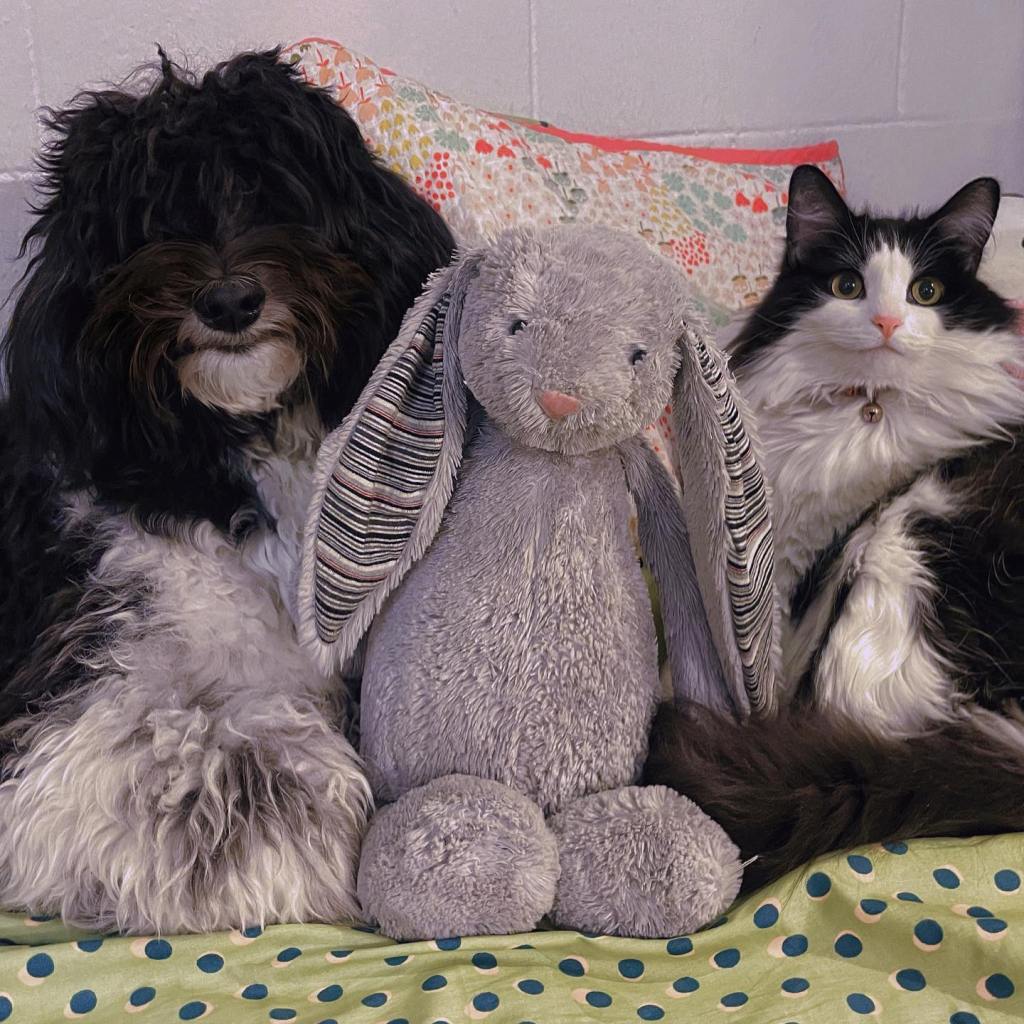
I know she’s with Princess Luna now, and one day… I know I’ll see them both again.
 TSIAN
TSIAN 