I used to think “sales strategy” was a mysterious dark art practiced by people in blazers who can smile on command and say things like “circling back” without flinching. Meanwhile, I’d like to think myself as a scientist. An artist. A person who thinks a perfect afternoon is spending 40 minutes adjusting a figure legend and calling it self-care. 🙂
And yet… here I am. In a job that requires sales techniques, business knowledge, and the emotional stamina to hear “we’re not interested” with a straight face. So I did what any scientist would do when dropped into an unfamiliar ecosystem:
I studied the species. I observed behavior. I built a hypothesis. I ran experiments.
(“Experiment” meaning: I tried a new approach, got humbled, then rewrote my script like it’s a grant proposal.) 😭😭😭
Below is my “sales theories I accidentally learned” diary entry—written by someone who still identifies as a scientist, but now treats calendar invites like tactical equipment. 📅⚔️
1) The “Sales Funnel” is Just… Sample Prep
Everyone talks about funnels like it’s sacred geometry. But it’s literally the same idea as any lab workflow:
Awareness = someone notices your existence. 🙂 Interest = they ask a question (or stare at your flyer). 🙂 Consideration = they compare options. 🙂 Decision = they buy / try / agree to a pilot. 🙂 Retention = they come back because you didn’t ruin their week. 🙂
In science terms: you don’t jump from “Hello” to “Publishable Results” in one step.
In sales terms: you don’t jump from “Nice meeting you” to “So do you want 50 antibodies?” 😅😅😅
Key lesson: Stop treating every conversation like a one-shot WB for your protein of interest. Some are just… loading controls.
2) People Don’t Buy Products. They Buy “Less Pain”
I used to think selling was about features:
“High affinity.” “Specificity.” “Validated.” “Works in IHC.” 🔬
Then I learned people are mostly buying:
less troubleshooting! 😭 less risk! 😭 less time wasted! 😭 less PI rage! 😭 and…… fewer “why is this band here” questions at lab meeting! 😭
So the real product is: confidence + time + peace. Your antibody isn’t “a reagent.” It’s “two weeks of not suffering.”
3) “Discovery Questions” = Scientific Interviewing
In sales training, they say “ask discovery questions.” In my head: Oh, you mean a structured interview to identify variables and constraints.
Examples: 👀 What are you trying to prove? 👀What’s the model system? 👀What’s the readout? 👀What failed before? 👀What would success look like?
This is literally experimental design, but the experiment is: their decision-making process.
And yes, you can absolutely think of it as: “I’m not selling, I’m collecting metadata.” 🧠
4) Pipeline is Just a Lab Notebook That Pays Rent
Scientists love data. So when I first saw CRM/pipeline talk, my brain went: “Oh. This is a lab notebook, but for humans.” 📝
A good pipeline isn’t “pushy.” It’s organized: Who did I talk to? What do they care about? What’s the next step? What’s the timeline? What’s the blocker?
If you don’t track it, your life becomes: “Wait… did I already follow up with Dr. X… or did I dream that?” 😵💫
5) Positioning: You’re Not Competing on “Best,” You’re Competing on “Best For This”
This one hurt my ego in a healthy way.
In science, we want “the best antibody.” In reality, people want the best antibody for their exact experiment.
So positioning is basically: “This is ideal for your application……” “This one has the validation you actually need……” “This fits your model species and readout……”
Not “We’re amazing!!!” More like “This solves your specific problem with fewer surprises.” ✅
6) Objections Are Just Peer Review, But Out Loud
When someone says: “It’s too expensive.” “We already have one.” “We’re not sure it’ll work.” “Send info.”
I used to take it personally, like they rejected my soul. Now I treat objections like reviewer comments: Not an insult Not the end Just a request for clarity, proof, or risk reduction 📌
Response strategy: clarify the real concern, show evidence,and offer a low-risk next step (sample, pilot, small order, side-by-side test).
Peer review vibes. But faster. And sometimes with emojis. 👍
7) Follow-Up is Not Annoying If It’s Useful
I feared following up because I didn’t want to be “salesy.” Then I realized: unhelpful follow-up is annoying. Helpful follow-up is service.
Bad follow-up: “Just checking in.” 🙃
Good follow-up: “Here’s the exact datasheet for your application.” “Here’s an IHC image in your species.” “Here’s a quick comparison to what you’re currently using.” “Here’s a suggestion to avoid cross-reactivity / background.”
If you bring value, you’re not bothering them. You’re saving them time. ⏳
8) Trust Is the Real Currency (and It Builds Slowly)
Scientists don’t buy because you’re enthusiastic. They buy because they trust you won’t waste their time.
Trust is built with: 😝being honest when you don’t have a good option, 😝being specific instead of vague, 😝sending the right info instead of all the info, 😝remembering what they care about, and following through when you say you will. 🤝
It’s like collaborations: nobody wants a collaborator who overpromises and disappears.
9) The “Close” Doesn’t Have to Be Dramatic
I thought “closing” meant: “So are you ready to purchase today?” 😬
No. Closing can be gentle and nerdy: “Want to try one for a pilot?” “Should we start with the application you care about most?” “If I send X + Y, can you tell me which one fits your setup?” “What’s a reasonable next step on your end?”
Closing is just: agreeing on the next experiment. 🧪
10) My Final Theory: Sales is Applied Empathy + Systems Thinking
If I had to write it like a scientist:
Sales strategy = (empathy + evidence + timing) × consistency
❤️empathy: understand the human and their constraints. ❤️evidence: show data, reduce risk. ❤️timing: align with their funding / deadlines / project phase. ❤️consistency: follow-up, pipeline, long-term relationships.
Anyways. Now that I have sales THEORY (capital T, because I read things and now I’m dangerous), the real question is: how did I actually do? 😭
Let me start with a confession from my previous life—the lab life. Back then, I had a very specific relationship with sales reps: avoidance with a side of guilt.
I didn’t hate sales people. I just… didn’t want to talk. I liked doing my own product research like it was a literature review. I didn’t buy anything new without my PI’s approval, because nothing says “career growth” like accidentally ordering the wrong kit and getting emotionally demolished at lab meeting.
So I developed a coping strategy: If a sales email looked even slightly friendly, I sent it straight to the spam folder. If a rep asked “Do you have a minute?” I suddenly remembered I had to… centrifuge air. And vendor shows? I treated them like Costco: I went for free food, free pens, and free samples like a morally confused raccoon. 🦝
I wasn’t rude. I was just… practicing stealth mode. Well, maybe I was rude. 🥲
Then the role flipped.
Now I’m the one sending the emails. Now I’m the one saying “Hi! Just following up!” like a person who’s totally fine and not fighting for my life inside. Now I’m the one who has to be brave enough to stand there—next to the vendor show table—smiling like an emotionally stable adult while holding flyers.
The irony is so strong it could denature protein.
And I did it. I walked through all those labs.
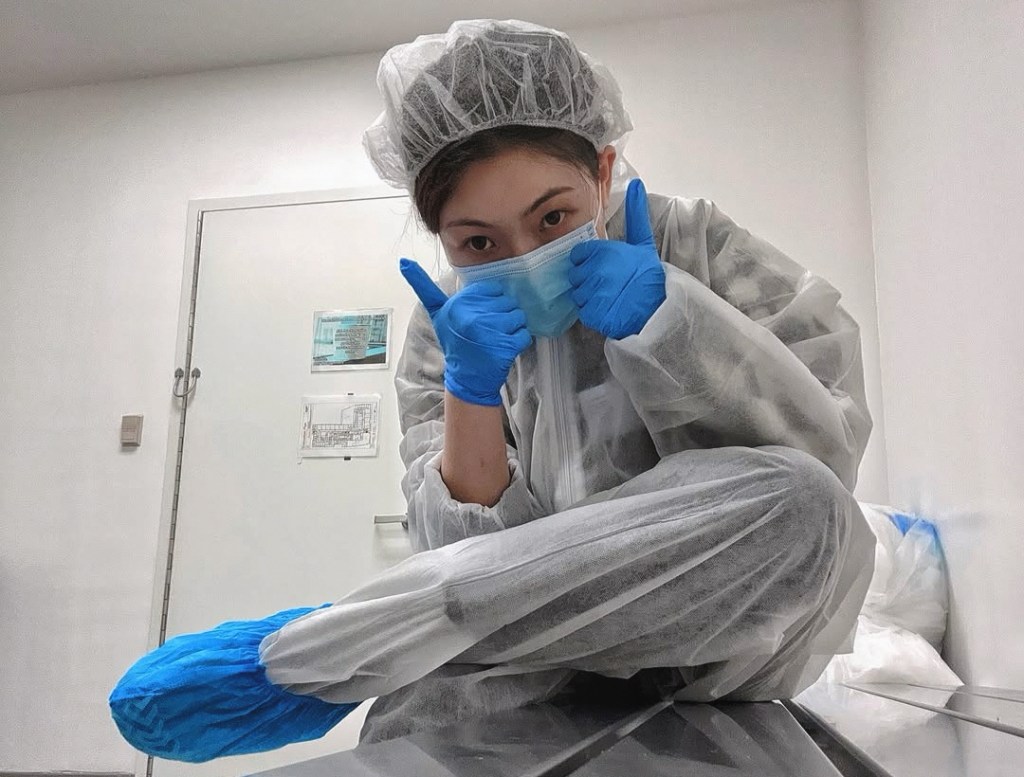
👀Longwood Medical Area—where every building looks like it contains either Nobel dreams or a very expensive autoclave. 👀Boston College. BU. Tufts. All those campuses where I used to be the person inside the lab, half-awake, wearing gloves, pretending I wasn’t hungry, and thinking, “Please no one talk to me, I’m busy suffering in silence.” 🙂Now I’m on the outside of those doors.
Sometimes I pass by benches where someone’s eating lunch out of a Tupperware like it’s a sacred ritual. Sometimes I see a postdoc speed-walking like the universe is chasing them. Sometimes I catch a glance of a lab coat swinging past a doorway and I get this weird phantom feeling—like my old self is still inside there, pipetting, ignoring emails, surviving on caffeine and denial.
And there I am, in the hallway, trying to introduce myself. Not to sell like a cartoon villain. But to connect.
Because here’s what no one tells you: standing at a vendor show table isn’t actually about pushing products. It’s about standing in public with your name and your face attached to your offer, saying:
“I’m here. I exist. If your experiment is falling apart, I might be able to help.” 🤝🙂
That’s the deep part. It’s humbling.
In the lab, your identity can hide behind data. Behind protocols. Behind “I’m just running samples.”
In sales, you’re the one walking in. You’re the one being perceived. You can’t hide behind a western blot. You can’t label yourself as “control lane” and quietly disappear.
Sometimes you stand next to the vendor show tables and you watch people do the exact thing you used to do: they grab the free gifts and pretend they didn’t, they avoid eye contact like it’s an immune response, they say “I’ll take a flyer” the way you say “I’ll respond to this email” (which means: never). 😅
And instead of being offended, I feel… tender about it.
❤️Because I know what it feels like to be in the lab, drowning in experiments, and having zero emotional bandwidth to talk to someone about new products. ❤️I know what it feels like when your PI has opinions, your budget has limits, and your brain is already overheating.
So now, when I stand there handing out flyers, I’m not thinking: “Please buy this.”
I’m thinking: 👍“Please don’t waste six months on an antibody that lies.”
👍“Please don’t spend your only budget on something that doesn’t work in your species.”
👍“Please find something that saves you time, because time is the only thing you can’t reorder.” 🧪⏳
And that’s the irony that gets me.
I used to avoid sales like it was an annoying pop-up ad. Now I am the pop-up.
But I’m also… the human version of the part I wished existed back then: someone who actually understands what it’s like to troubleshoot, to fail quietly, to rerun gels, to repeat staining, to beg the results to make sense.
😝So yeah. I walked through these labs, not as a lab person trying to hide. But as a lab person who stepped outside—still carrying that old empathy in my pocket—trying to make sure other people suffer just a little less.
And if the universe wants to keep laughing at me, fine! I’ll be at the vendor show table, smiling politely, holding flyers, and watching someone approach like:
“I’m just here for the free food.”
And I’ll nod like:
“Same.” 😝🍪
 TSIAN
TSIAN 