
🐇🔬 Let’s be honest: rabbit monoclonal antibodies (rabbit mAbs) have a reputation, and there are a few very different ways to do that. Each method is basically a different personality type of science:
👀Some are classic and old-school. 👀Some are biotech wizardry. 👀Some involve viruses doing the work for you. 👀And some feel like you’re physically pulling the antibody straight out of the immune system with tweezers.
Let me walk you through the four main ways rabbit mAbs are made—in Tsian style😝.
First: why rabbits are so good at this (and why they’re not just “bigger mice”😂)
When you immunize an animal, you’re basically giving the immune system a “wanted poster” for your target protein. B cells that can recognize it get activated, then they start evolving like crazy in germinal centers—mutating their antibody genes and competing until the best binders win.
💪Rabbits often generate antibodies with higher apparent affinity and broader epitope coverage, thanks to a highly diverse humoral repertoire produced during affinity maturation (extensive somatic hypermutation and diversification). 🐰This makes them particularly effective for conserved or weakly immunogenic targets where murine tolerance can limit responses, and for fine epitope discrimination among closely related protein family members (less cross-reactivity). The result is frequently better signal-to-noise in applications like IHC/IF—basically, when the antigen is being difficult, rabbits tend to respond like: “cool, I love a challenge.” 🐇🔬😌
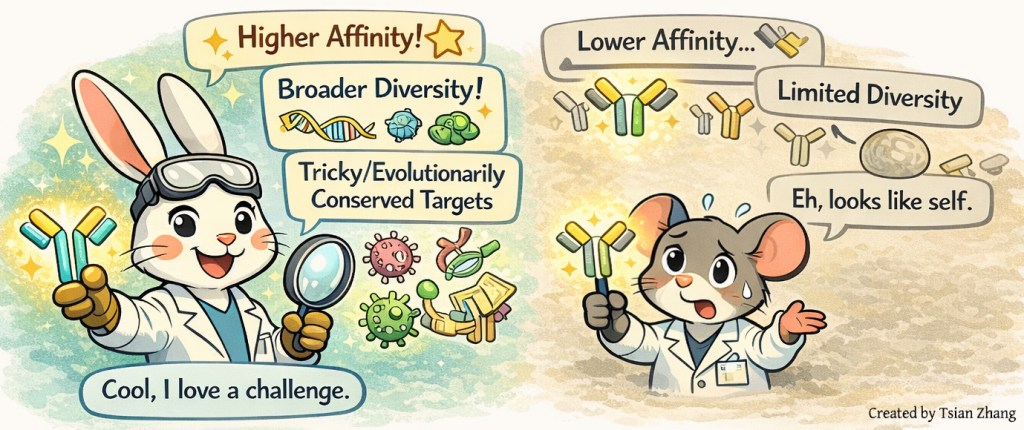
So the rabbit already does the hardest part: making a bunch of smart antibodies.
👉🏻Your job is to pick one of those antibodies, and make sure it becomes a stable, renewable product that acts the same every time. That’s what “monoclonal” really means: one clone, one antibody, one consistent personality.😃
Now… how do we capture that clone? 😈
1) Hybridoma: the classic “immortal cell marriage” method
Hybridoma technology is basically the original monoclonal recipe, and it has main-character energy.
Here’s the concept: antibody-producing B cells are amazing, but they don’t live forever. So scientists take those B cells and fuse them with an immortal cell line (a myeloma-like cell) that can divide endlessly. The fused cell is called a hybridoma, and it’s like an antibody factory that never clocks out. 🏭💅
In practice, it’s a process of “make a giant mess first, then find the one perfect thing.”
So! You immunize the rabbit, collect B cells from lymphoid tissue, do the fusion step, then grow thousands of fused cells in plates. Most of them are useless. 🥲Some don’t grow. Some grow but don’t make antibody. Some make antibody but it binds the wrong thing (classic😂). And somewhere in that chaos, 🥹there’s a clone making a beautiful antibody… quietly minding its business.😍
Once you find that clone, you keep subcloning it until you’re sure the population truly comes from one single antibody-producing cell. That’s the “monoclonal” purity step—and it’s why hybridoma work can feel like a VERY LONG and exhausting relationship where you keep asking:
“Are you really the one?” 😅
Hybridoma is reliable and historic, but in rabbits it can be technically more demanding than in mice. Still, it remains an important route, especially if you want a very classic monoclonal workflow.
2) Phage display: letting viruses run your antibody audition
Phage display is one of those methods that sounds fake until you remember biology is unhinged.
The “phage” part means bacteriophage—a virus that infects bacteria. The “display” part means we can genetically engineer the phage so it displays an antibody fragment on its surface… while carrying the DNA sequence inside that encodes it.
So each phage is basically a tiny walking résumé:
“Hi, I’m an antibody fragment. Here’s my body. Here’s my genetic code. Please hire me to bind this antigen.” 🦠📄
Instead of growing immune cells, phage display creates a massive library of antibody variants (often millions to billions). You mix the library with your antigen, wash away weak binders, keep strong binders, then amplify them in bacteria and repeat.
That repeated cycle is called panning, and it’s basically antibody hunger games.
What you get at the end is a shortlist of antibody fragments that bind your target. Then you convert the best ones into full antibodies (such like full IgG, or single-domain antibodies), express them in mammalian cells, and 😎confirm they behave like real functional antibodies.
Phage display can be faster than some classic methods and gives you a huge pool of candidates. But it has a “dating app problem”: sometimes the heavy and light chain pairing isn’t the natural pairing that existed inside the original B cell. That pairing matters because antibodies are like teamwork—some heavy chains and light chains are soulmates, and some are just coworkers who shouldn’t share a project. 💀
Phage display is a fantastic discovery engine—especially when you want lots of options, or when classic cell-based methods are annoying.
3) NGS + proteomics: “let’s read the immune system’s diary”
This method feels the most like futuristic science! Instead of growing antibody-producing cells and hoping the right clone survives, this approach says:
“What if we just sequence the antibody repertoire and figure out what the immune system made?”
NGS (next-generation sequencing) can read a huge number of B-cell receptor sequences. That tells you what antibody variable genes exist in the rabbit after immunization, including which ones expanded strongly. 💡Then proteomics (mass spec) can help connect what’s in blood/serum to actual antibody proteins, so you’re not just staring at DNA—you’re finding sequences tied to real antibodies.
❤️The dream scenario is: you identify a gorgeous antibody sequence, synthesize the genes, express it recombinantly, and you’ve got your monoclonal!
🖤The reality scenario is: you still have to solve a classic headache—pairing.
Antibodies have a 👀heavy chain and 👀light chain, and the exact pairing matters. If you don’t preserve the original pairing, you can recreate a sequence that looks impressive on paper but doesn’t bind properly in real life. So this method can be powerful, 🤔but it often needs clever experimental design to keep heavy/light pairing accurate (or extra validation work afterward).
This approach is incredible for exploring diversity and quickly mining candidates—like digging for treasure with a genome-scale metal detector. 🧲🧬
4) Single B cell cloning: the “no mix-ups allowed” method
This is the cleanest, and it’s also the most satisfying when it works. Single B cell cloning is basically:
“Find the B cell that makes the antibody I want… and copy-paste it.”
Instead of mixing B cells together and hoping you find the right one later, you isolate individual antigen-specific B cells, one by one, usually using flow cytometry—you tag your antigen with a fluorescent label, let B cells bind it, then sort single cells into individual wells.
After you sort single antigen-specific B cells (one cell per well), you don’t have to jump straight into gene amplification right away. In some workflows, the first move is more like: “Talk to me first. What do you actually make?” 😅
You keep the single B cell alive and encourages it to proliferate and differentiate into an antibody-secreting cell. This usually means adding stimulation signals that mimic what B cells would see in the body—think CD40 signaling plus immune cytokines like IL-21 (often also IL-4), and sometimes co-culture with feeder cells to provide extra survival help. The goal isn’t to culture them forever; it’s just to coax each single B cell to make enough secreted IgG that you can test it. 🧫✨
After a short culture period (often around a week or two, give or take), you take a small sample of the supernatant from each well and do a quick functional screen—usually something simple and scalable like ELISA against your antigen, or a binding assay using antigen-coated beads or cells. Now you can confidently say:
✅ “This well is secreting IgG that binds my target.”
❌ “This one is alive but making nothing useful.”
❌ “This one binds everything like a chaotic gremlin.” 🙃
Only after you’ve identified wells with genuinely promising secreted antibodies do you commit to the “deep cloning” step: you go back to the winning wells, harvest those B cells, and then amplify the paired heavy and light chain genes from that same clone, preserving the natural pairing. 🧬🧬🧬You clone those genes into expression vectors, express recombinant IgG in mammalian cells, and do the more serious validation screens (specificity, affinity, WB/IHC/FC compatibility, etc.).
Single B cell cloning is the method that feels the most like:
“I want the real thing, and I want it clean.” 🧼✨
The part everyone learns the hard way: “binding” is not the same as “works in my assay”
This is where monoclonals get humbled.
An antibody can bind beautifully to an antigen in ELISA… then completely fail in Western blot because the protein is denatured and the epitope is linearized. Or it can work in Western but fail in IHC because fixation masks the epitope. Or it can be great in purified protein assays but fall apart when faced with the toxic soup known as “cell lysate.”
So after discovery, every antibody goes through the real test: Does it work in the application we actually care about?
That means screening for things like: 👀binding specificity, 👀background noise, cross-reactivity, 👀performance in real sample types, and 👀whether it recognizes linear vs conformational epitopes.
So… which method is “best”?
Honestly? In my opinion, none of them are “the best.” They’re just different tools for different goals.
❤️Hybridoma is classic and stable but slower and sometimes harder in rabbits.
❤️Phage display is fast and flexible but may sacrifice natural pairing.
❤️NGS/proteomics is powerful for mining sequences but still needs reconstruction validation.
❤️Single B cell cloning preserves the immune system’s original pairing and often gives beautiful antibodies, but it takes careful technique.
If rabbit monoclonals had a summary statement, it would be: The rabbit immune system writes the masterpiece. We’re just trying not to smudge it while photocopying. 🥹🐇📄✨
 TSIAN
TSIAN 